Digi – Electronics Store WooCommerce Theme
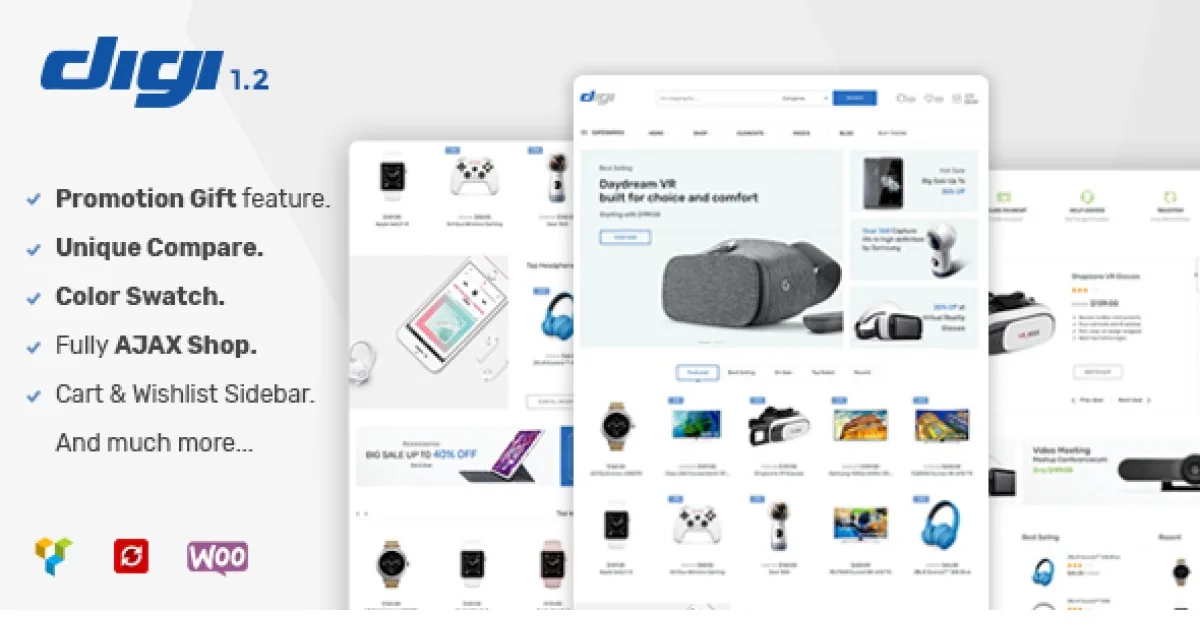
Digi Electronics AJAX WooCommerce Theme is a WordPress storefront codebase with six demos, AJAX filtering, and compare modules for developer-led retail builds.
- Daily automated updates
- VirusTotal 0/70 clean
- Licensed under GPL
- Secure 256-bit checkout
- Instant direct cloud link
What Is Digi Electronics AJAX WooCommerce Theme?
Digi is a WordPress WooCommerce theme, engineered for developers and agencies building electronics storefronts that require asynchronous shop interactions without page reloads. It resolves the common bottleneck of high-friction product browsing by routing catalog actions through AJAX requests, keeping shoppers on the same DOM context while filtering, comparing, or paging through products. In production workflows, it functions as a deployable storefront skeleton that teams wire to a WooCommerce catalog and launch under standard WordPress hosting.
Key Features of the Theme
The theme executes catalog interactions client-side: input events trigger XMLHttpRequest calls against WooCommerce endpoints, and returned markup fragments replace targeted containers in the DOM tree, avoiding full-page navigations. Template hierarchy overrides native WooCommerce files so shop, archive, and single-product views render through the theme’s own layout engine.
Architectural Highlights
- Six Prebuilt Home Demos: Home 01 through Home 06 provide distinct landing page compositions, letting developers pick a baseline layout and strip, reorder, or extend its template sections during client builds.
- Shop Filter Module: Attribute and category filtering dispatches AJAX requests to re-render the product grid in place, reducing LCP regression caused by full document reloads during narrow-down browsing.
- Compare Products Module: Product comparison state is tracked per session and rendered through a dedicated comparison template, a common requirement for electronics catalogs where spec-level differentiation drives conversion.
- Four Product Layouts Plus Products Slider: Products Layout 1 through 4 and a Products Slider element give grid, list, and carousel renderings for merchandising zones on both home and archive templates.
- Gifts Dropdown and Gifts Popup: Promotional gift components surface incentive offers via dropdown and popup containers, handled as front-end presentation layers over the WooCommerce cart context.
Agencies running adjacent vertical storefronts can reuse this AJAX-driven interaction pattern elsewhere in their stack; for hyperlocal grocery catalogs with zone-based shipping, Nest applies the same WooCommerce-plus-Elementor architecture to distance-based delivery, while OchaHouse packages a comparable demo-import structure for specialty tea shops.
Who Should Use This Theme?
This theme fits WordPress developers and small agency teams delivering client electronics stores who want prebuilt WooCommerce templates rather than building shop archives from scratch. It suits projects where AJAX catalog behavior, comparison tables, and promotional gift widgets are baseline requirements and the team will handle custom CSS/JS integration themselves. It is not intended for non-technical store owners expecting drag-and-drop page authoring without developer oversight, nor for headless commerce builds requiring a decoupled front end, since this codebase renders through the native WordPress template hierarchy.
Compatibility & Runtime Requirements
The package operates within the standard WordPress and WooCommerce runtime envelope, with no exotic server configuration documented.
| Engineering Metric | Deployment Specification |
|---|---|
| Base Technology | WordPress Theme (PHP templates, standard asset enqueue pipeline) |
| Runtime Baseline | Standard WordPress Core Environment |
| Parent Ecosystem Dependency | Native WooCommerce Dependency (shop, cart, and product data layer) |
| Data Transport | AJAX request/response fragments over WordPress admin-ajax and WooCommerce endpoints |
| Front-End Output | Server-rendered HTML with asynchronous container replacement |
Real-World Use Cases & Implementation
Three production scenarios map directly to this architecture. First, a consumer electronics retailer launching a multi-category catalog deploys Home 01 as the entry template and switches product grid rendering to one of the four layouts based on SKU density, using the Products Slider for featured and deal zones on the homepage. Second, a store running seasonal promotions activates the Gifts Dropdown and Gifts Popup elements to attach incentive messaging to cart-adjacent containers without custom plugin development. Third, an agency managing checkout integrity for a client catalog layers reCaptcha for WooCommerce on top of the theme to gate login, registration, and checkout forms against bot traffic, while pairing the storefront with WooCommerce Active Payments to constrain which payment methods are offered per shipping method — a common requirement whenCOD-style payments must be restricted to certain delivery zones. In each case, the theme serves as the presentation engine while these companion modules handle verification and payment logic at the WooCommerce layer.
Frequently Asked Questions
Does the theme include more than one homepage design?
Yes, the package ships six home demos labeled Home 01 through Home 06, each providing a distinct landing composition that developers can select as the deployment baseline.
Are product filtering and comparison handled without page reloads?
Yes, the Shop Filter and Compare Products modules operate through AJAX requests, replacing product grid containers in place instead of triggering full document reloads.
How many product grid layout variations are included?
Yes, four product layouts (Layout 1 through 4) plus a Products Slider element are included, giving developers multiple renderings for archive and merchandising zones.