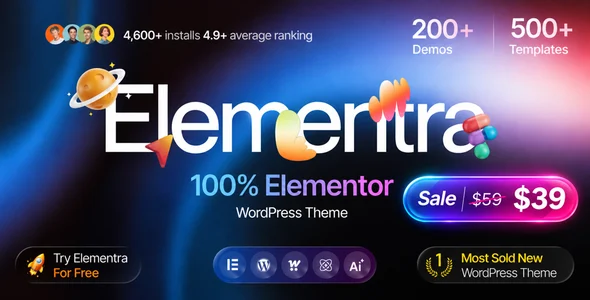
Elementra – 100% Elementor WordPress Theme
Elementra WordPress Theme is a multi-skin Elementor V4 theme with Atomic widget support, WooCommerce integration, and 750+ Customizer options for agencies.
- Daily automated updates
- VirusTotal 0/70 clean
- Licensed under GPL
- Secure 256-bit checkout
- Instant direct cloud link
What Is Elementra?
Elementra is a multi-skin, multi-purpose WordPress theme, engineered for agencies and freelance developers to assemble corporate, retail, and service websites inside Elementor V3 and V4. It resolves the bottleneck of maintaining separate codebases per client vertical by shipping interchangeable skins and pre-designed page sets spanning law, finance, marketing, medical, education, and sports sectors. In production, it functions as a one-click demo-installable foundation that developers then override through a Customizer layer of 750+ options and Elementor-driven header and footer layouts.
Key Features of the Theme
The theme renders pages by dispatching Elementor widget trees through ThemeREX Addons, which supplies custom widgets, shortcodes, and template-import transformers on top of the native WordPress template hierarchy. Header and footer DOM structures are themselves built in Elementor rather than hard-coded PHP templates.
Architectural Highlights
- Elementor V4 Atomic support: Version 2.0.0 added full Atomic widget compatibility, an Atomic-built demo, and 100% Atomic templates in the ThemeREX Template Library, with theme fonts and colors exposed as locked predefined variables in the Atomic editor.
- Setting inheritance system: A 750+ Customizer option panel applies inheritance and override logic, letting global values cascade while individual pages override locally.
- AI Helper integration: Assistant chats migrated to the OpenAI Responses API with Conversations and Vector Stores; the image generator supports current OpenAI models after DALL-E 2/3 retirement, and the content generator outputs into Atomic Grids.
- WooCommerce toolchain: Compatibility extends through WooCommerce 7–11, with product filters, swatch output via the trx-wcext plugin, Quick View, Compare support, and a dedicated ‘woo-template’ post type for shop page templates.
- Hardened asset pipeline: CSS/JS minification was rewritten in 2.1.0 for edge cases such as comments inside regular expressions, and rtl.css now emits as a separate block after responsive styles when assets move to the head.
Teams running adjacent builds can compare this architecture with Profecient, which takes a 40+ demo approach to the same Elementor business niche, or with Willows for GSAP-driven creative agency work.
Who Should Use This Theme?
This codebase targets development teams and solo consultants delivering multiple client sites per quarter: agencies serving law firms, UX/UI studios, branding bureaus, and app developers, plus store builders who need WooCommerce feeds, product filters, and Elementor Pro product tabs. It also fits WaaS operators, since WaaS-based service keys and WordPress.com output-buffering controls are explicitly handled. It is not intended for developers who want to hand-code block themes purely in Gutenberg; although Gutenberg is optimized and supported with editor style-loading options, the primary rendering contract is Elementor.
Compatibility & Runtime Requirements
Baseline runtime constraints follow the standard WordPress Core environment, with documented support spanning a wide release range and major ecosystem plugins.
| Engineering Metric | Deployment Specification |
|---|---|
| Base Technology | WordPress theme, PHP Files, CSS Files, JS Files |
| WordPress Range | 4.9.x through 7.1.x, fully compatible with 7.0+ |
| Page Builder | Elementor V3+ and V4 (Atomic widgets) |
| Commerce Dependency | WooCommerce 7.x–10.x (description states 11+ support) |
| Plugin Ecosystem | Elementor Pro, WPML, TutorLMS, Events Calendar, GiveWP, Yoast SEO, WP Rocket, MetForm, Loco Translate |
| Browsers | Firefox, Safari, Opera, Chrome, Edge |
| Layout | Responsive, boxed and fullwidth, Retina-ready, widget-ready |
Real-World Use Cases & Implementation
Scenario one: a digital agency deploying a corporate site with a blog can import a demo in one click, then restyle header/footer layouts directly in Elementor while the inheritance system keeps typography and color tokens consistent across 20+ post animations and multiple blog feed configurations.
Scenario two: a mid-size WooCommerce store with 20,000+ products benefits from the search widget’s auto-detected filters, which sort attribute names, skip attributes with filtering disabled, and query faster at scale; the Product Filter Widget adds item filtering and scrollable attribute lists beyond 15 items.
Scenario three: a multilingual consulting build combines WPML with Loco Translate, while GiveWP, Events Calendar, and TutorLMS extend it into fundraising, events, or course platforms without custom glue code.
Frequently Asked Questions
Does the theme require a specific plugin set before demo import?
Yes. Elementor and ThemeREX Addons drive rendering, and when WooCommerce is active the setup recommends installing the free trx-wcext plugin from WordPress.org for swatches, attribute data, and shop page templates.
Can third-party code override bundled WooCommerce components?
Yes. Dedicated WooCommerce API filters disable individual TrxAddons components such as custom attribute types and the Product Filters widget so third-party plugins can register conflict-free equivalents.
Which vulnerabilities were patched in the 2.1.0 release?
The release fixed SSRF vectors in SVG loading and AI uploads, Stored XSS in the Background Text extension, presets, and Instagram widget, plus macro processing and PHP Object Injection in settings decoding, reported via Patchstack.