Blueprint – Next-Generation Blog Magazine Theme
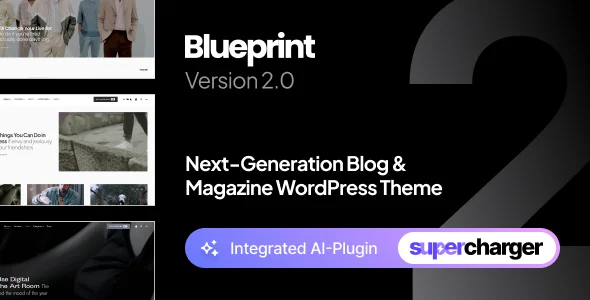
Blueprint WordPress Theme is a blog and magazine package for publishers and agencies, with dark mode, 9 demo sites, REST API pagination, and WPML support.
- Daily automated updates
- VirusTotal 0/70 clean
- Licensed under GPL
- Secure 256-bit checkout
- Instant direct cloud link
What Is Blueprint WordPress Theme?
Blueprint WordPress Theme is a PHP/CSS/JS publishing package engineered for bloggers, magazine teams, and agencies building content-heavy sites on WordPress 6.6.x through 7.0.x. It resolves the recurring bottleneck of bloated theme frameworks by shipping dependency-free CSS, on-demand REST API data fetching, and modular feature loading through the Powerkit plugin. In production, it serves as a self-hosted editorial foundation that operators configure entirely through the native Customizer without editing template files.
Key Features of the Theme
The package executes through standard WordPress template hierarchy overrides, rendering archive and single-post views via PHP templates whose markup classes align with Google structured data expectations. All configuration inputs pass through the Customizer live-preview layer, so option changes render in the preview pane before any database write commits.
Architectural Highlights
- REST API Archive Loading: The Load More and Infinite Load modes request subsequent archive pages through the WordPress REST API rather than full-page reloads, reducing server round-trips and keeping database load proportional to actual demand.
- Lazy Mega-Menu Fetching: Thumbnail content inside menu dropdowns is requested dynamically on hover of the parent item, preventing unnecessary queries on every page render and avoiding the classic mega-menu database overhead.
- Native Sticky Positioning: The sticky sidebar and navigation behaviors rely on the browser’s native sticky CSS positioning instead of scroll-event JavaScript loops, which eliminates flicker on tablets and mobiles and lowers main-thread work, directly benefiting CLS and LCP measurements.
- Modular Powerkit Companion Plugin: Share buttons, social link counters, newsletter opt-in forms, sliders, tiled galleries, lightbox, and image lazy loading ship as individually disableable modules, so unused features contribute no asset weight.
- Adaptive Image Size Strategy: The engine generates a minimal set of thumbnails, serves images at original or near-original dimensions, and never downscales, cutting disk usage and speeding regeneration cycles on large media libraries.
Additional mechanics include a dark mode driven by browser preferred-color settings or a manual toggle, automatic white text/link inversion when dark header or footer backgrounds are selected, duplicate-post exclusion from the main archive to protect crawl integrity, AMP styles activated via the official AMP plugin, and Yoast-compatible breadcrumb placement styled automatically. For publishers weighing alternatives in this category, JNews WordPress Theme offers a 78+ demo visual builder pipeline, while teams wanting a lighter editorial baseline may evaluate Fabula News Magazine WordPress Theme as a comparable Elementor-driven engine.
Who Should Use This Theme?
This codebase targets professional publishers, multi-author editorial teams, freelancers, and agencies delivering lifestyle, travel, fashion, or food content properties. Developers extending the platform benefit from exposed actions and filters, a child-theme override path, WordPress Coding Standards compliance, and a .pot file supporting POEdit or Loco Translate workflows, with WPML and Polylang for multilingual rollouts. Co-Authors Plus integration covers guest-author and multi-author byline structures. It is not intended for users who require a drag-and-drop visual builder inside the theme itself: configuration is Customizer-based and Gutenberg-optimized rather than a bundled page-builder interface.
Compatibility & Runtime Requirements
Baseline runtime constraints center on a standard WordPress LAMP stack, with the package requiring no additional server extensions beyond core.
| Engineering Metric | Deployment Specification |
|---|---|
| Base Technology / Framework | WordPress theme, dependency-free CSS (no Bootstrap), Gutenberg/Block Editor optimized |
| Runtime / Language Requirements | WordPress 6.6.x–7.0.x; PHP, CSS, JS files included |
| Data Exchange / Communication Protocols | WordPress REST API for infinite load, share counts, and social follower counters |
| Core Dependencies / Engine Compatibility | Contact Form 7, WooCommerce 9.x–10.x, WPML, Polylang, Yoast SEO, Co-Authors Plus, official AMP plugin, Powerkit |
| Database / Storage Footprint | Minimal generated thumbnail set; dynamic count fetching avoids transient-heavy writes and caching-plugin conflicts |
How to Install & Deploy the Theme
Deployment follows the standard WordPress theme initialization workflow, completing in minutes on any compliant host.
- Environment Pre-check: Confirm the server runs WordPress 6.6.x or newer and that PHP meets current core requirements; verify plugin prerequisites such as Powerkit, Yoast, AMP, or Co-Authors Plus are available if those features are planned.
- Package Upload: Upload the theme archive via Appearance → Add New in the administration interface, or transfer the PHP, CSS, and JS files directly to wp-content/themes using SFTP.
- Direct Activation: Click Activate; navigation systems, archive layouts, header types, and the Customizer option layer become operational immediately, with no additional setup screens.
- Configuration & Testing: Import one of the nine demo starter sites (posts and images included), assign archive layouts and sidebar positions, configure ad spots and banner locations, then validate pagination modes, dark-mode toggling, and structured data output on a staging URL before production cutover.
Frequently Asked Questions
Does the Infinite Load feature work with caching plugins?
Yes. Post fetching runs through the REST API, and share or follower counts are requested dynamically after page load, so cached HTML stays valid and static caching layers do not conflict with the pagination or counter systems.
Is RTL and multilingual publishing supported out of the box?
Yes. The package includes built-in RTL styles for Arabic, Hebrew, Persian, and similar scripts, ships a .pot file for POEdit or Loco Translate, and is compatible with both WPML and Polylang for multilingual site structures.
Can ads be placed without touching template files?
Yes. Predefined banner and AdSense-ready ad spots are configurable through the Customizer, and the Additional Content feature inserts arbitrary markup into template parts, removing the need for child-theme template overrides in most placements.