Couponer – Coupons & Discounts WP Theme
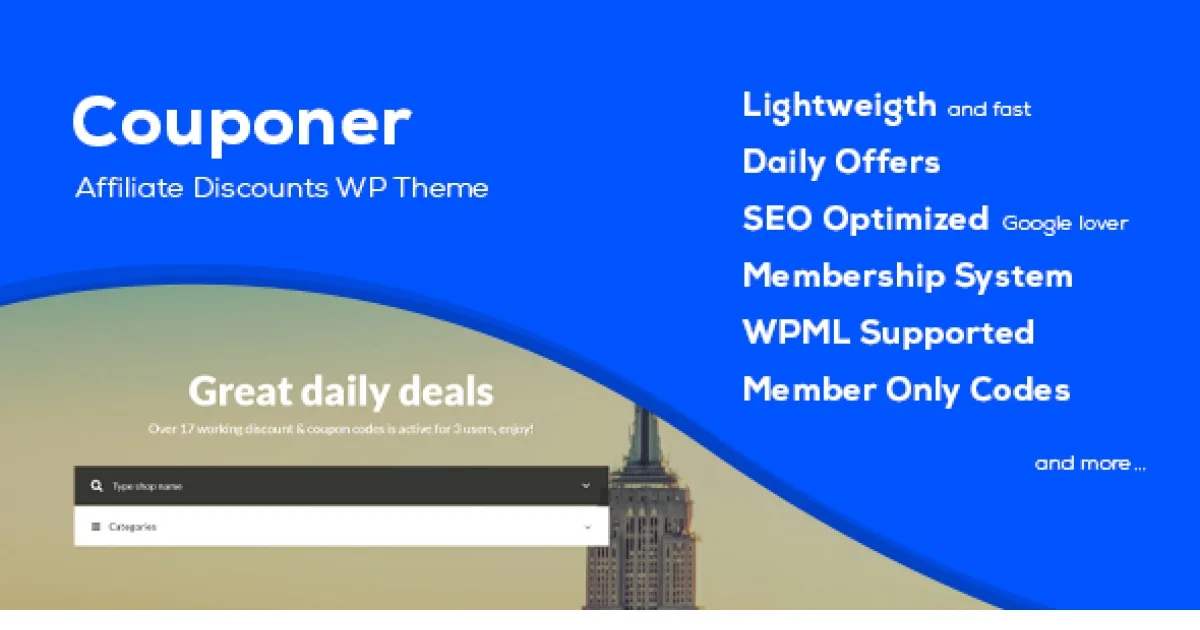
Couponer Coupons Discounts WordPress Theme: a coupon distribution theme with ten prebuilt layout variants for developers building WordPress voucher and discount portals.
- Daily automated updates
- VirusTotal 0/70 clean
- Licensed under GPL
- Secure 256-bit checkout
- Instant direct cloud link
What Is Couponer – Coupons & Discounts WordPress Theme?
Couponer – Coupons & Discounts WordPress Theme is a WordPress theme engineered for developers and agencies building coupon aggregation and discount distribution portals. It resolves the recurring bottleneck of assembling bespoke voucher layouts for every client vertical by shipping ten distinct coupon presentation modules that cover consumer, tech, travel, and brand-specific storefront scenarios. In production workflows, it functions as the front-end rendering layer of a WordPress installation, sitting on top of the native template hierarchy to serve category-driven coupon pages and discount listings.
Key Features of the Theme
The theme executes by routing WordPress template hierarchy requests into prebuilt coupon display modules, each of which maps a vertical niche to a dedicated layout structure and renders discount data within the standard WordPress rendering pipeline.
Architectural Highlights
- Ten Vertical Layout Modules: The package includes Coupon 1, Coupon 2, Coupon 4, and Couponer New as generic coupon presentation structures, letting developers switch display archetypes per client requirement without rebuilding templates.
- Brand-Oriented Demo Variants: Adibas, Tobisha Couponer, Twentus, and Travel Coupon provide vertical-specific layouts for brand stores, electronics discount portals, and travel deal sites, reducing template authoring time for niche deployments.
- Tech-Focused Coupon Structures: Tech Coupon and Coupon Computers define DOM layouts targeted at gadget and computing discount listings, isolating markup for category-heavy catalog pages.
- WordPress Template Hierarchy Integration: As a native WordPress theme, it operates through the standard template loading order, so developers can override individual template parts via child theme copies rather than patching the parent codebase.
- Category-Driven Publishing Fit: Because the layout modules are page-structure driven, this architecture pairs naturally with timestamped, category-based publishing stacks such as Pressroom – News and Magazine WordPress Theme when an agency runs adjacent editorial and voucher properties on shared infrastructure.
Who Should Use This Theme?
The codebase targets WordPress developers and small agencies delivering client coupon sites, discount aggregators, and brand-deal portals on standard WordPress hosting. It fits teams that want prebuilt vertical layouts they can restyle through CSS and child theme overrides instead of composing pages from scratch. Teams operating multi-concept agency portfolios may benchmark it against sibling codebases such as Wanium Theme, which offers broader demo coverage but different vertical focus. It is not intended for non-technical operators who need fully visual drag-and-drop page assembly, nor for headless decoupled builds where the WordPress presentation layer is bypassed entirely.
Compatibility & Runtime Requirements
Runtime constraints follow standard WordPress hosting baselines, since no bespoke server stack is documented for the package.
| Engineering Metric | Deployment Specification |
|---|---|
| Base Technology / Framework | WordPress Theme (PHP rendering layer) |
| Runtime / Language Baseline | Standard WordPress Core Environment (PHP / MySQL) |
| Parent Ecosystem Dependency | WordPress template hierarchy and native post types |
| Rendering Model | Server-side template rendering within WordPress |
| Data Formats | WordPress content structures; standard WP database storage |
Real-World Use Cases & Implementation
Three production scenarios map directly onto the module set. First, a discount aggregator for consumer electronics can deploy Tech Coupon or Coupon Computers as its primary listing structures, mapping product categories to coupon cards without custom template authoring. Second, a travel-deal portal can adopt the Travel Coupon module to present destination-based offers, then extend monetization by attaching WooCommerce-driven voucher products at checkout using Flexible PDF Coupons PRO Advanced Sending to generate and deliver coupon PDFs. Third, an agency maintaining multiple client coupon sites can standardize on the generic Coupon 1 / Coupon 2 / Coupon 4 variants as base layouts and differentiate each client through brand-oriented modules such as Adibas or Tobisha Couponer, keeping a single maintenance surface across projects. Implementation follows normal WordPress theme activation: upload the package, activate it, then assign layout modules per page template.
Frequently Asked Questions
Does the theme require any additional plugins to display its coupon layouts?
No. The documented module set is self-contained within the theme package; the ten coupon layouts render through WordPress template structures, and additional plugins are only needed when extending functionality beyond the documented scope.
Can the layout modules be overridden without editing the parent theme files?
Yes. As a standard WordPress theme, individual template parts can be copied into a child theme and modified there, preserving the parent codebase so parent-side maintenance does not overwrite custom structural changes.
Is the Travel Coupon module restricted to travel-vertical sites only?
No. Travel Coupon is a layout structure, not a data constraint; any WordPress content assigned to its template will render through that module, though the layout design is oriented toward destination-based deal presentation.