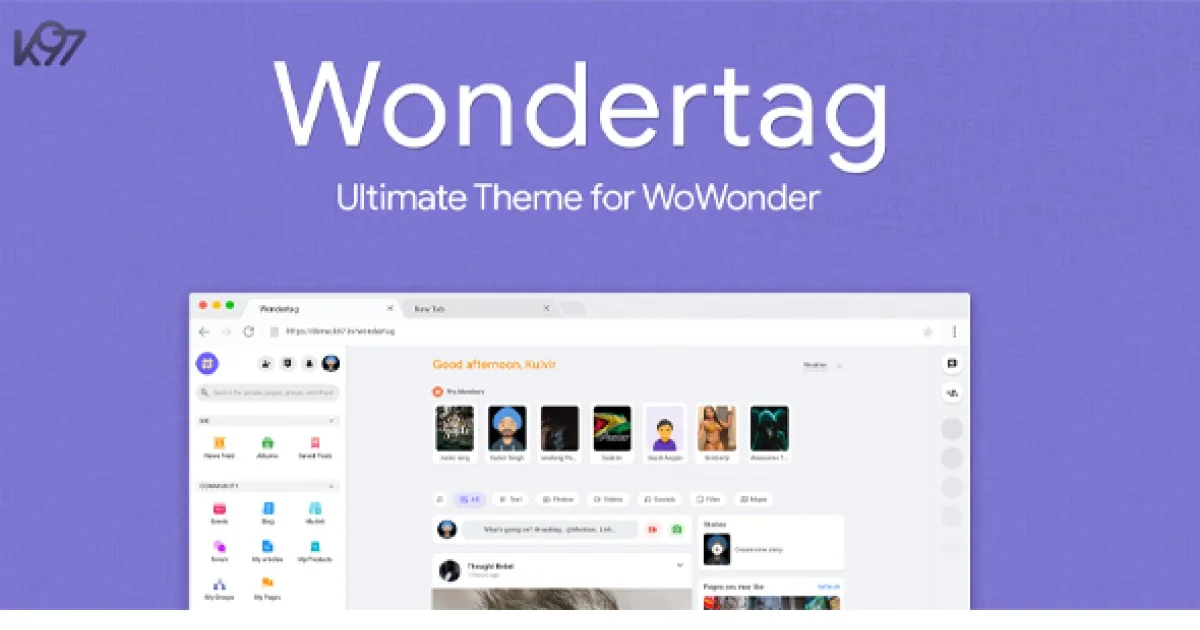
Wondertag Theme
Wondertag Social Networking WordPress Theme is a BuddyPress-driven community codebase for developers building membership, social, and user-generated content platforms.
- Daily automated updates
- VirusTotal 0/70 clean
- Licensed under GPL
- Secure 256-bit checkout
- Instant direct cloud link
What Is Wondertag Social Networking WordPress Theme?
Wondertag Social Networking WordPress Theme is a BuddyPress-based WordPress theme engineered for developers and agencies building self-hosted social communities, membership platforms, and user-generated content networks. It resolves the core bottleneck of adapting BuddyPress activity streams, profile pages, and messaging components into a coherent front-end experience without manual template surgery. In production, it serves as the presentation and interaction layer for community-driven WordPress deployments.
Key Features of the Theme
The theme intercepts BuddyPress component templates and re-renders them through its own layout engine, so activity feeds, member directories, and private messaging inherit a unified DOM structure and styling scope.
Architectural Highlights
- BuddyPress Template Overrides: Replaces the native BuddyPress template hierarchy with themed counterparts for member profiles, activity loops, groups, and notification screens, keeping component data loops intact while altering only markup and asset layers.
- AJAX Activity Interactions: Posting status updates, liking, commenting, and favorite actions dispatch through asynchronous requests, so feed state updates without full-page reloads, reducing server render cycles on high-traffic community pages.
- Profile-Centric Navigation: Member profile pages expose tabbed sub-navigation wired to BuddyPress components, letting users traverse profile fields, friend lists, messages, and media uploads within a single routing context.
- Login and Registration Screens: Custom front-end authentication markup replaces wp-login.php defaults, aligning sign-up and sign-in flows with the community’s design system.
- Responsive Grid Architecture: Member and group directories render through responsive card grids with viewport breakpoints, maintaining scanability across mobile and desktop widths.
Who Should Use This Theme?
This codebase targets WordPress developers and agencies deploying BuddyPress on client community projects — internal company networks, niche membership sites, and multi-user content platforms. Teams comfortable wiring BuddyPress components, adjusting child theme files, and auditing plugin conflicts will extract the most value from the template override structure. It is not intended for non-technical site owners expecting a drag-and-drop page builder experience with zero PHP exposure; front-end behavior remains coupled to BuddyPress and WordPress runtime conventions.
Compatibility & Runtime Requirements
Deployment depends on a standard WordPress Core environment with the BuddyPress plugin active, since every social component routes through BuddyPress controllers.
| Engineering Metric | Deployment Specification |
|---|---|
| Base Technology | PHP-based WordPress theme |
| Parent Ecosystem Dependency | WordPress Core with BuddyPress plugin activated |
| Component Rendering | BuddyPress template hierarchy overrides (activity, members, groups, messages) |
| Interaction Protocol | AJAX-based asynchronous state updates |
| Content Authoring | Standard WordPress editor and media library workflows |
Limitations & Technical Considerations
The theme is functionally scoped to WordPress single-site deployments with BuddyPress as the social engine; it does not ship its own database schema or standalone backend, so all user, group, and message persistence is delegated to BuddyPress tables and WordPress core tables. Developers should verify third-party BuddyPress addon compatibility before staging, because custom component plugins that register their own template directories may bypass the theme’s override layer. Multisite network activation requires per-site configuration rather than a single network-wide theme assignment. For content creators who need a lighter community-adjacent deliverable, a travel or editorial build on Maaya Travel Blog WordPress Theme offers Gutenberg and Elementor layouts without BuddyPress coupling, while commerce-heavy community extensions can pair the codebase with a storefront layer such as Ochaka Premium Multipurpose WooCommerce Theme on a separate installation.
Frequently Asked Questions
Does the theme function without the BuddyPress plugin installed?
No. The core social components — member profiles, activity streams, groups, and private messaging — render exclusively through BuddyPress template overrides, so the plugin must be active for the theme’s primary functionality to operate.
Are demo content files included for staging reproduction?
Yes. The package ships with demo import assets replicating the preview configuration, letting developers reproduce the reference layout in a staging environment before adapting markup to client-specific requirements.
Can custom profile field groups be added through the WordPress admin?
Yes. Profile fields are managed through BuddyPress’s native admin interface, and the theme’s profile templates render additional field groups automatically without requiring direct PHP edits to member markup.