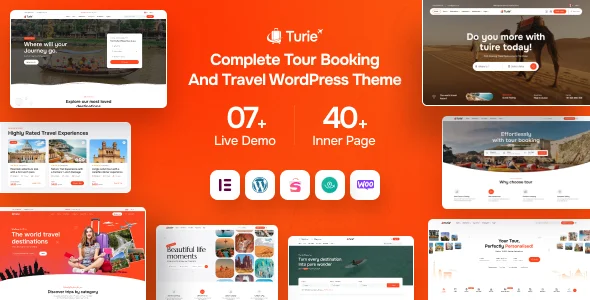
Atlastrip – AI Powered Tour & Travel Booking WordPress Theme
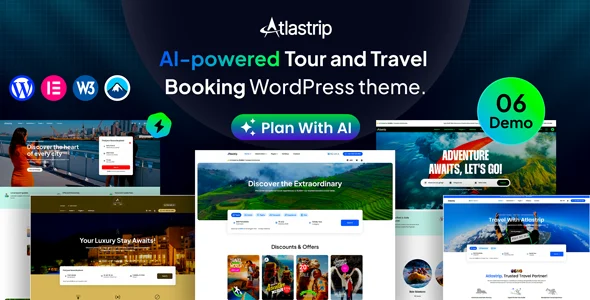
Atlastrip is an AI-powered travel booking WordPress theme with WooCommerce checkout, Elementor widgets, WPML support and visa, tour, hotel modules for agencies.
- Daily automated updates
- VirusTotal 0/70 clean
- Licensed under GPL
- Secure 256-bit checkout
- Instant direct cloud link
What Is Atlastrip?
Atlastrip is a PHP, SCSS and JavaScript-based WordPress Theme, engineered for agencies and tour operators to run tours, hotels, rooms, visa services and transport bookings on a single WooCommerce-driven site. It resolves the fragmentation problem where travel businesses must stitch together separate booking, visa and AI chat systems by consolidating listing management, checkout and an AI Travel Assistant into one dashboard. In production, it functions as a deployable storefront layer over WordPress 6.0.x through 7.0.x, replacing custom template development with Elementor widget composition.
Key Features of the Theme
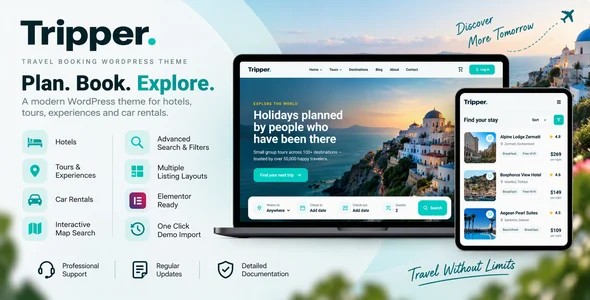
The codebase registers custom post types for tours, hotels, rooms, visas and destinations, renders their archive and single templates through the WordPress template hierarchy, and hands booking transactions to WooCommerce cart and checkout endpoints. Elementor builds every page layout, while the AI assistant queries your own listings before pushing selected items into the cart. The most impactful mechanics for architects reviewing comparable packages — for instance the real booking engine approach in Tripper — center on how listing data, availability state and cart entries stay synchronized across AJAX calls.
Architectural Highlights
- AI Travel Assistant: Connects to OpenAI, Claude, Gemini or any OpenAI-compatible provider via your own API key; it answers visitor queries, recommends tours and hotels from on-site listings, appends items to the WooCommerce cart, and captures custom package requests for back-office review.
- Multi-Entity Booking Schema: Separate management flows for tours, hotel room types with services and pricing packages, visa listings, and transport — all resolved to WooCommerce products for checkout, so payment state machine logic remains native WooCommerce rather than a parallel engine.
- Visa Processing Module: Visa records are filterable by country, category, residence and citizenship, exposing processing time, pricing and application forms as structured data rather than flat pages.
- AJAX Search and Filter Pipeline: Quick search plus faceted filters on destination, duration, activity, price, category and deals issue asynchronous queries against listing collections, avoiding full-page reloads during refinement.
- Package Builder Workflow: A multi-step form collects destination, dates, traveler count and notes, then posts the assembled request to the admin dashboard as a lead rather than a paid order.
Supporting these core systems are 300+ custom Elementor widgets, six importable demos (Main Home, Travel Agency, Adventure, City Tour, Hotel & Resort, Single Hotel), an Elementor-built header, footer and mega menu builder with per-page assignment, destination guide templates covering highlights, culture, seasons and related tours, plus review ratings, a wishlist, popup login/registration with a My Account dashboard, and a travel blog combined with booking conversion paths. For agencies extending listing fields beyond the bundled schema, pairing it with Advanced Custom Fields Pro lets developers register additional tour or visa attributes without editing template PHP directly.
Who Should Use This Theme?
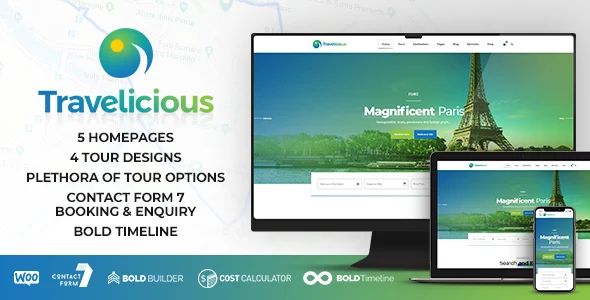
It fits agencies building client sites for tour operators, hotel and resort groups, visa consultancies and online travel platforms that need booking, multilingual content and AI-driven triage without custom development. WordPress developers comfortable with Elementor widget configuration, WooCommerce product mapping and WPML string translation will find the structure predictable. It is not intended for teams requiring Gutenberg-native editing (the package is explicitly not Gutenberg optimized), headless decoupled frontends, or operators who refuse to provision their own LLM API keys — the assistant has no bundled inference service. Teams evaluating alternative tour-commerce stacks, such as the Bold Builder-based Travelicious, should compare template override depth before committing.
Compatibility & Runtime Requirements
Baseline deployment requires a standard LAMP stack running a supported WordPress core version with WooCommerce and Elementor installed as active dependencies.
| Engineering Metric | Deployment Specification |
|---|---|
| Base Technology / Framework | PHP, SCSS, JavaScript; Bootstrap 5.x presentational layer |
| Runtime / Language Requirements | WordPress 6.0.x through 7.0.x; server PHP per WordPress minimums |
| Data Exchange / Communication Protocols | OpenAI-compatible HTTP APIs (OpenAI, Claude, Gemini) using your own key; AJAX endpoints for search; Mailchimp for newsletters |
| Core Dependencies / Engine Compatibility | WooCommerce 9.x.x and 10.x.x, Elementor, Elementor Pro, Contact Form 7, WPML |
| Database / Storage Footprint | Standard WordPress and WooCommerce tables via custom post types and meta; no proprietary schema documented |
How to Install & Deploy the Theme
- Verify the server runs a WordPress version in the 6.0.x–7.0.x range, then install and activate WooCommerce, Elementor (and Elementor Pro if used), Contact Form 7 and WPML as required by your build scope.
- Upload the package archive through the WordPress administration theme installer, or extract the PHP, SCSS and JS file tree into wp-content/themes/ over SFTP; a child theme is included for safe overrides.
- Activate the theme in the admin panel; booking modules, custom post types, widget registrations and administrative menus initialize on activation.
- Run the one-click demo importer to load one of the six demos with pages, tours, hotels, menus and settings, then configure the AI provider API key, WooCommerce checkout, visa filters and WPML field translations, and validate search, room booking forms and checkout output on staging.
Frequently Asked Questions
Does the AI Travel Assistant require an external service subscription?
No. It connects to OpenAI, Claude, Gemini or any OpenAI-compatible provider using an API key you supply, so inference costs and provider selection remain entirely under your infrastructure control.
Is the theme compatible with the block editor?
No. The package is explicitly not Gutenberg optimized; all page construction, headers, footers and mega menus are built and assigned through Elementor and Elementor Pro instead.
Can the site operate in multiple languages?
Yes. WPML configuration covers every tour, hotel, visa and destination field, theme options and Elementor widgets, and translation-ready .pot files ship for the theme and bundled plugins.