Automize – Car Auto Parts WooCommerce Theme
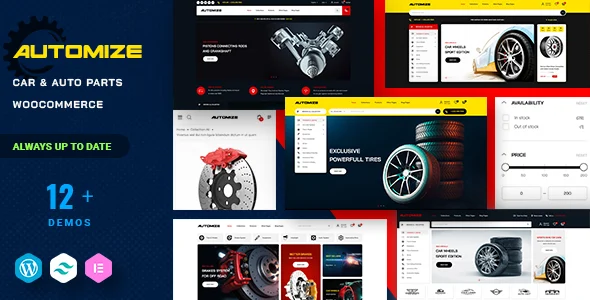
Automize is a Tailwind CSS WooCommerce WordPress theme for auto parts stores and repair shops, with 12 Elementor homepages and one-click demo import.
- Daily automated updates
- VirusTotal 0/70 clean
- Licensed under GPL
- Secure 256-bit checkout
- Instant direct cloud link
What Is Automize Car Auto Parts WooCommerce Theme?
Automize Car Auto Parts WooCommerce Theme is a WordPress theme built on the Tailwind CSS framework, engineered for developers and agencies to launch automotive eCommerce storefronts without writing custom template code. It resolves the recurring bottleneck of balancing visual customization depth against CSS payload weight by pairing a utility-first stylesheet with Elementor-driven layout composition. In production workflows, it functions as the storefront layer over WooCommerce 5.x–10.x, handling catalog rendering, cart transitions, and merchandising surfaces for parts retailers, tire shops, and repair garages.
Key Features of the Theme
The theme’s execution flow routes page requests through the WordPress template hierarchy, where WooCommerce templates override native loops to render shop, product, and checkout states, while Tailwind utility classes govern the DOM presentation layer and Elementor widgets manage editorial content blocks. Version 1.3.8 ships as PHP, CSS, and JS files with widget-ready regions and a 4+ column layout system.
Architectural Highlights
- Tailwind CSS Presentation Layer: Utility classes are purged at build time to strip unused selectors, reducing stylesheet size versus component-framework alternatives and improving LCP on catalog pages.
- 12 Prebuilt Homepage Layouts: Distinct front-page configurations for parts dealers, service garages, and tuning shops, each assembled from Elementor sections rather than hard-coded PHP.
- Elementor and Elementor Pro Integration: Layout, banner, and landing-page construction occurs through the builder’s widget API, keeping structural edits out of theme files and preserving update paths.
- WooCommerce-Optimized Commerce Flow: Cart-to-checkout states are rendered through the platform’s native templates, retaining standard hooks and filters for payment and shipping extensions.
- One-Click Demo Import: A packaged importer provisions demo content, menus, and widget assignments in a single pass, collapsing staging setup to minutes.
For teams comparing storefront stacks in the same vertical, evaluating Bigxon — a parts-and-tools WooCommerce theme with AJAX filtering and vehicle-fit lookup — clarifies how alternative catalog architectures trade filtering behavior against Automize’s Tailwind-based payload efficiency.
Who Should Use This Theme?
The package targets WordPress developers and small agencies delivering client storefronts for brake kits, lighting upgrades, engine parts, or workshop tool catalogs, particularly where one-product or niche landing pages must ship quickly. Its Gutenberg-optimized and widget-ready structure also suits teams maintaining mixed-editor publishing workflows. It is not intended for developers needing vehicle-fitment databases, VIN-based product matching, or headless REST-only storefronts — those requirements demand plugin-layer extensions beyond the theme’s documented scope, as provided by dedicated alternatives like Autoas, which packages demo-imported shop layouts specifically for tire and accessory retailers.
Compatibility & Runtime Requirements
Deployment requires a standard WordPress core environment with WooCommerce active as the commerce engine and Elementor available for page composition.
| Engineering Metric | Deployment Specification |
|---|---|
| Base Technology | WordPress theme with Tailwind CSS utility layer |
| Parent Ecosystem | WordPress 5.4.x through 7.0.x; WooCommerce 5.x.x through 10.x.x |
| Builder Dependency | Elementor and Elementor Pro compatible |
| Form Handling | Contact Form 7 compatible |
| Editor Support | Gutenberg optimized, widget-ready regions |
| Browser Matrix | Firefox, Safari, Opera, Chrome, Edge |
| Rendering | Responsive layout, Retina/High-Resolution assets |
Performance & Architectural Considerations
Server-side delivery cost concentrates in the CSS layer. Tailwind’s purge step removes unused utility classes from the shipped stylesheet, so a page only downloads selectors actually present in its DOM — a measurable reduction against Bootstrap’s full component grid, which typically loads component CSS regardless of usage. This directly lowers LCP on product-archive pages where image-heavy part grids dominate. Because responsive behavior is expressed as breakpoint utilities in the markup rather than separate media-query blocks, layout shifts (CLS) are controlled at the element level without additional stylesheets. Client teams running multiple verticals — for example, pairing this theme with a grocery codebase such as Bfres on shared infrastructure — should still verify that Elementor’s runtime scripts and WooCommerce cart AJAX remain within their memory and cache ceilings under load.
Frequently Asked Questions
Can Automize operate without Elementor installed?
No. The theme’s layout system is built around Elementor widgets, and its 12 homepage configurations are assembled through the builder. Gutenberg optimization covers blog content, but full storefront composition requires the Elementor plugin active.
Does the package include the demo content for all 12 homepages?
Yes. The one-click demo import provisions packaged demo layouts, menus, and widget assignments from the theme files, letting staging environments replicate the reference storefront before custom catalog data is imported.
Is the storefront limited to car parts, or can it handle other catalogs?
It extends to bike parts, wheel and tire shops, tools equipment, and general garage inventory. Because commerce runs on native WooCommerce templates, any product taxonomy renders through the same template hierarchy without code changes.