Web Directory plugin for WordPress
Web 2.0 Directory plugin is a WordPress directory engine for developers building classifieds, business listings, and monetized directory sites with custom content types.

- Daily automated updates
- VirusTotal 0/70 clean
- Licensed under GPL
- Secure 256-bit checkout
- Instant direct cloud link
What Is Web 2.0 Directory plugin?
Web 2.0 Directory plugin is a WordPress directory plugin, engineered for developers and agencies to build business listings, classifieds, and member directories on standard WordPress installs. It resolves the bottleneck of assembling directories from fragmented custom post types, taxonomies, and form plugins by consolidating listings, categories, claims, and payments into a single codebase. In production, it operates as the core content engine of a directory site, with WordPress themes handling presentation and the plugin handling listing lifecycle and data management.
Key Features of the Plugin
The plugin registers dedicated directory content types and renders listings through its own views, hooking into WordPress core for routing, querying, and persistence. Inputs submitted from front-end forms are validated, written to custom data structures, and immediately reflected in directory index pages, search results, and single-listing templates.
Architectural Highlights
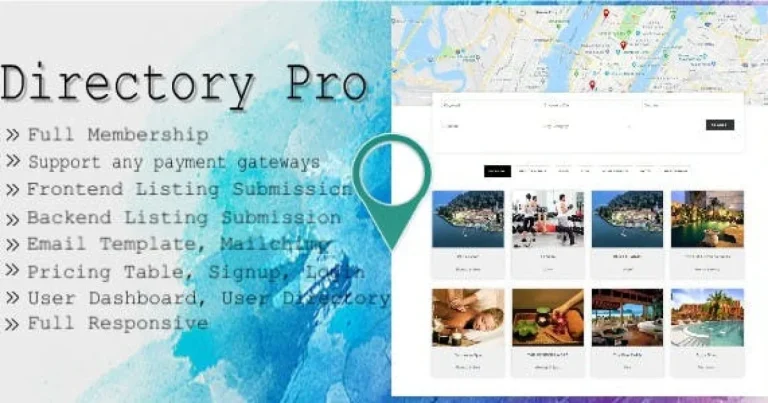
- Custom Directory Content Types: Each directory section defines its own content type with assignable fields, categories, and tags, so a single site can run independent directories (businesses, events, classifieds) without schema collisions.
- Front-End Listing Submission: Registered users create and manage listings via front-end forms; submissions pass validation before being persisted, avoiding direct wp-admin exposure for contributors.
- Claim and Moderation Workflow: Existing entries can be claimed by owners, and administrator moderation queues gate what becomes publicly queryable, giving teams editorial control over index quality.
- Built-In Monetization Paths: Paid listing plans, featured/raised placement levels, and payment integration let operators charge for inclusion or elevated visibility, replacing ad-hoc WooCommerce plumbing for listing commerce.
- Map and Location Views: Listings carrying address data render on map-based index views alongside standard list layouts, with radius and address-driven filtering for geo-sensitive directories.
For teams needing a theme-layer alternative where listing types are composed visually in Elementor, deploying MyListing pairs comparable directory architecture with front-end layout control, while the plugin remains the fit when content mechanics must live at the plugin layer, independent of theme choice.
Who Should Use This Plugin?
This package targets WordPress engineers and agencies building client directories—local business indexes, service provider catalogs, or paid classified platforms—where listing fields, moderation, and monetization must be configured rather than hand-coded. It suits teams comfortable wiring taxonomies, configuring payment gateways, and overriding templates in a child theme. It is not intended for non-technical operators expecting a turnkey hosted SaaS: directory sections, fields, and checkout behavior all require deliberate configuration, and presentation-level changes assume template and CSS competence. Where the objective is a fully pre-designed directory storefront rather than a plugin-driven engine, a purpose-built theme such as ListPress may shorten the delivery path.
Compatibility & Runtime Requirements
The plugin runs as a standard WordPress extension and inherits the runtime ceiling of the host WordPress and PHP environment.
| Engineering Metric | Deployment Specification | |
|---|---|---|
| Base Technology / Framework | WordPress plugin (PHP, standard WP content model) | |
| Runtime / Language Baseline | Standard WordPress-supported PHP environment | |
| Parent Ecosystem Dependency | WordPress Core; theme acts as presentation layer | |
| Data Persistence | MySQL via WordPress custom content types and options | |
| Monetization Dependency | Configurable payment gateway integration for paid plans | |
| Media Handling | Native WordPress Media Library for listing images and logos |
Real-World Use Cases & Implementation
Three production scenarios demonstrate where the plugin’s mechanics resolve distinct operational bottlenecks. First, a local business index: an agency defines a business content type with hours, address, and contact fields, imports seed entries, enables claim submissions so real owners take custody of their cards, and charges for featured placement via paid plans. Second, a multi-directory membership site: separate directory sections with independent field sets serve verticals on one domain, each with its own categories and moderation queue, avoiding taxonomy collisions that arise when forcing directory data into shared post types. Third, a classifieds platform: front-end submission forms replace wp-admin for contributors, expiration and renewal of paid listings are handled by the plan system, and geo views with radius search serve location-sensitive queries. In content-heavy deployments where operators prefer AI-tool catalog patterns with importable seed listings and ad inventory, ToolboxAI offers an alternate SaaS-shaped route, while this plugin keeps the directory engine self-hosted and theme-agnostic.
Frequently Asked Questions
Can multiple independent directories run on a single WordPress installation?
Yes. Each directory section is configured as its own content type with separate fields, categories, and levels, so distinct directories coexist on one install without sharing taxonomy or schema definitions.
Can site visitors submit listings without wp-admin access?
Yes. The plugin provides front-end submission forms that validate input and persist listings, allowing registered contributors to create and manage entries without any backend dashboard exposure.
Does the plugin support owners claiming pre-seeded listings?
Yes. A claim workflow lets existing entries be claimed by their rightful owners, with administrator moderation determining which claims are approved before listing control transfers.
Is paid listing placement handled internally?
Yes. The plugin includes listing levels and paid plan mechanics with payment gateway integration, so featured or elevated placement is billed through the plugin’s own commerce flow.